
 Available in US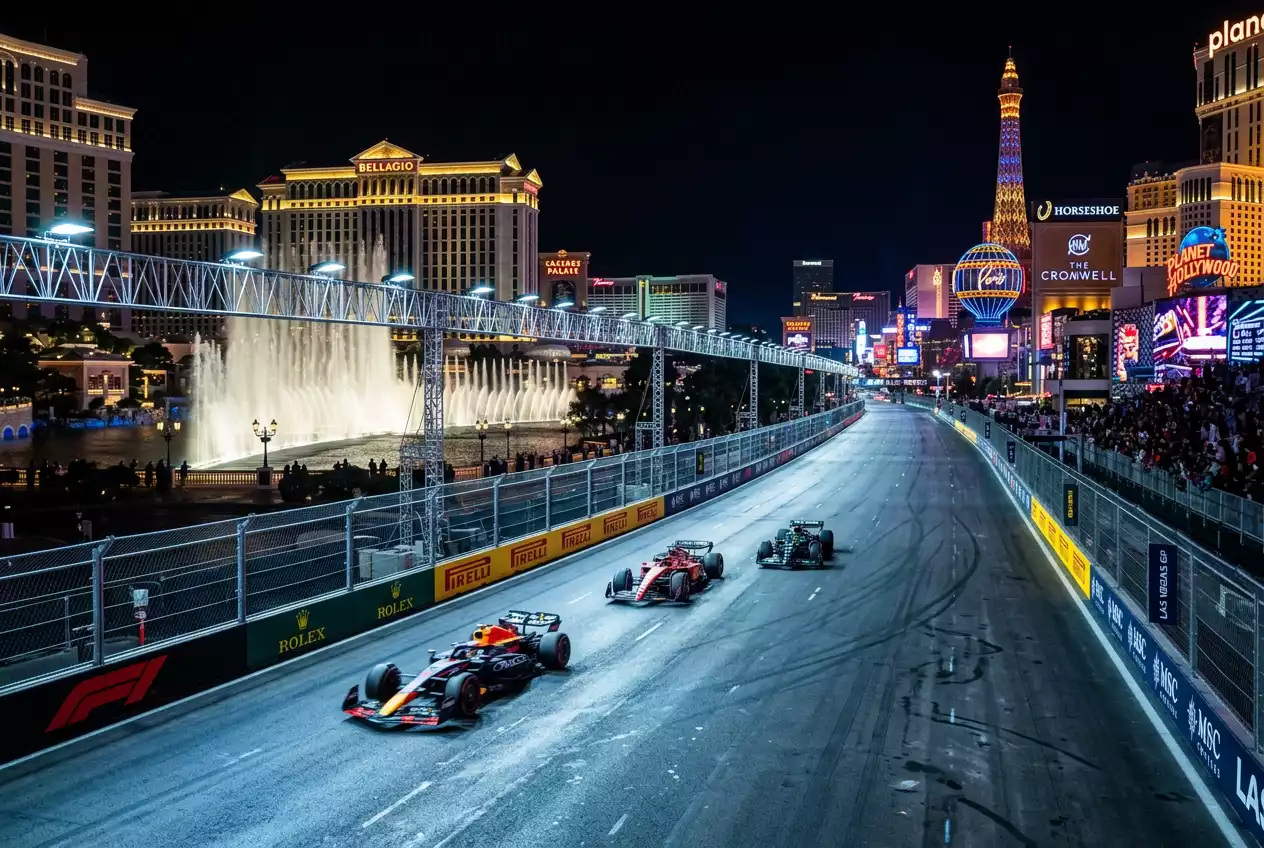
F1 Under the Casino Lights
The inaugural Las Vegas Grand Prix in 2023 turned every pre-race prediction inside out. A drain cover ripped through a car in practice, the race started at ten o’clock at night in near-freezing temperatures, and the competitive order scrambled so completely that the eventual podium looked nothing like the pre-weekend form guide. I had placed three bets that weekend — two lost, one hit at 12/1. That single winner more than covered the losses, and it landed because I had accounted for the one variable nobody was talking about: cold tyre grip.
Las Vegas races on the Strip in the early hours of the morning, local time, which translates to a European-friendly broadcast window. Track temperatures drop below ten degrees Celsius — a condition so far outside normal F1 operating parameters that it changes the fundamental physics of the tyres. The 1.83-billion cumulative TV audience watches a spectacle. Bettors who recognise the cold-temperature dynamics see an opportunity.
The Strip Circuit: Power and Cold Tarmac
The Las Vegas circuit features three significant straights, the longest running along the Strip itself at over 1.9 kilometres. That straight alone makes this one of the most power-sensitive circuits on the calendar. Top speeds exceed 340 kilometres per hour, and the advantage of a superior power unit is measured in multiple tenths per lap. DRS is devastating here — the length of the straights means a trailing driver can close enormous gaps and complete overtakes that would be impossible at shorter-straight circuits.
But the straights are only half the story. Between them sit tight, technical corners that demand low-speed mechanical grip — exactly the kind of grip that disappears when track temperatures are in single digits. Cold tarmac reduces the tyre’s ability to generate heat through surface friction, which means the compounds take longer to reach their operating window and offer less peak grip when they get there. Teams running softer compounds gain an initial advantage but risk higher degradation once the tyres do warm up. Teams on harder compounds struggle for grip in the opening laps but stabilise better over a stint.
This temperature dynamic is the key betting edge at Las Vegas. Practice sessions run at similar nighttime temperatures to the race, so FP2 data is genuinely representative — more so than at most circuits, where the practice-to-race temperature gap distorts the data. If a team’s long-run pace in the cold FP2 conditions is strong, you can trust that signal for the race with more confidence than usual.
Tyre Behaviour in Sub-Ten-Degree Conditions
I keep coming back to this because it is the single most misunderstood variable at this event. Pirelli’s tyre compounds are designed to operate in a temperature window, and that window typically starts around twenty degrees Celsius for the softest compound. At Las Vegas, the ambient temperature during the race sits at eight to twelve degrees, and the track surface — despite heating from the floodlights — struggles to reach fifteen degrees in some sections. The tyres are operating below their designed range for much of the race.
The practical consequence: graining. The tyre surface tears in tiny pieces rather than wearing smoothly, creating a layer of rubber debris between the tyre and the track that further reduces grip. Graining is temporary — it clears after a few laps as the surface rubber is worn away — but during the graining phase, a driver can lose one to two seconds per lap compared to their steady-state pace. Teams whose cars generate more tyre heat through suspension and aerodynamic loading manage the graining phase better and emerge with a performance advantage once the tyres stabilise.
For betting, track which drivers suffered the worst graining in practice and which cleared it fastest. A driver who grains heavily in the opening laps of a stint and then stabilises is following a predictable curve — the graining phase is a known cost that the rest of their stint compensates for. A driver who grains continuously without stabilising has a setup problem that will not resolve itself during the race. That distinction is worth several grid positions by the end of a stint and is frequently mispriced in head-to-head and podium markets.
DRS Zones and Overtaking Frequency
Las Vegas has two long DRS zones that produce frequent overtaking. This is not a Monaco-style procession — drivers can and do change positions throughout the race. The extended straights mean that a one-second pace advantage translates to an overtake almost every lap. A driver starting eighth with a car that has 0.3 seconds per lap better race pace than the drivers ahead will likely reach the podium by race end, purely through DRS-assisted passes.
This high overtaking rate changes the betting calculus. Qualifying position matters less at Las Vegas than at circuits where passing is difficult. A driver who qualifies poorly due to a mistake or traffic but has strong race pace is a live contender for a much better finishing position. The qualifying markets and race winner markets diverge more at Las Vegas than at most circuits, which creates arbitrage-like opportunities when a strong racer has a poor Saturday.
Sixty-three per cent of motorsport bettors wager between one and a hundred pounds per month. At Las Vegas, I would direct those modest stakes toward race-outcome markets rather than qualifying markets, because Sunday’s result is determined by race pace and strategy far more than grid position. The opposite approach works at Monaco or Zandvoort — but Las Vegas is their antithesis.
Night Race Scheduling and Its Impact on Market Timing
The Las Vegas race starts at 10 PM local time — 6 AM in the UK on a Sunday morning. This scheduling quirk matters for bettors because the market liquidity patterns differ from a standard Sunday afternoon European race. Fewer casual bettors are awake and placing bets during a 6 AM UK start, which means the live-betting markets are thinner and prices can be less efficient. Professional and semi-professional bettors who make the effort to watch live have a larger relative edge in the live markets than at a race with a standard broadcast time.
The pre-race market also behaves differently. Because qualifying takes place in the early hours of Saturday morning UK time, the post-qualifying odds adjustment happens while much of the UK betting public is asleep. By the time casual bettors check the markets on Saturday morning, the sharpest price movements have already occurred. If you are willing to set an alarm and check the odds immediately after qualifying, you can sometimes find residual value that has not been fully corrected.
Cold conditions, high overtaking rates, and thin markets at unusual hours — Las Vegas is a bettor’s circuit in every sense. The key is recognising that the standard analytical framework needs temperature-adjusted inputs and a willingness to engage with the market at unconventional times. Those who adapt their process to the circuit’s unique demands will find edges that the daytime-only punter never sees.
