
 Available in US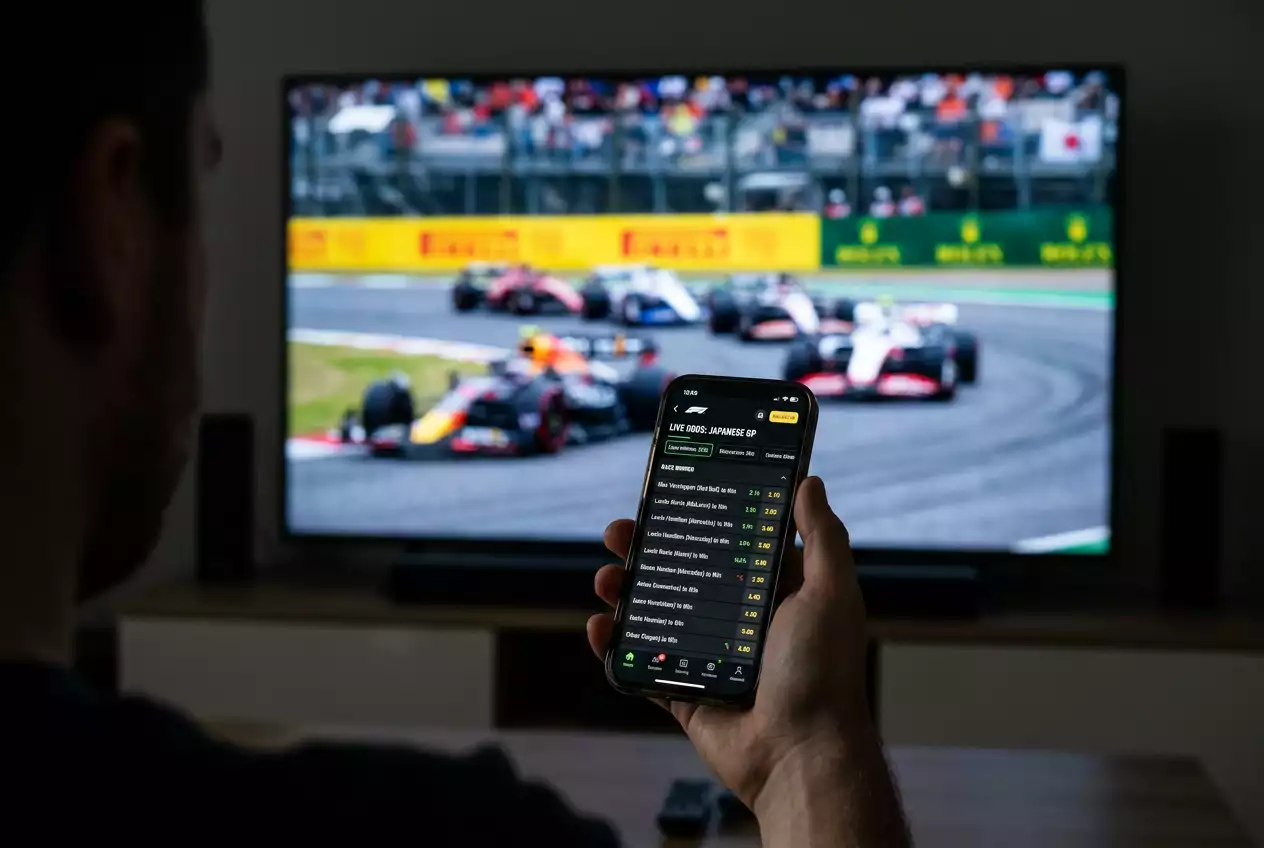
What Happens to F1 Odds the Moment Lights Go Out
Lap 14, Bahrain 2024. I had a pre-race bet on a podium finish at 7/2 that looked comfortable — the driver was running third with stable tyres and a clean pit window ahead. Then the team radio crackled with a power unit warning, pit wall scrambled for data, and within ninety seconds the in-play odds on that same driver went from 1.40 to 3.50. The pre-race price I had locked in was suddenly generous. The live market had repriced the entire race in less time than it takes to complete a sector.
That speed is what makes F1 live betting fundamentally different from pre-race wagering. In football, the game state changes gradually — a goal every forty-five minutes on average. In F1, the competitive picture can invert in the time between two corners. A safety car, a puncture, a rain shower, a botched pit stop — each event triggers an instantaneous repricing of every runner in the field.
A third of F1 fans under 35 say they are more likely to watch a race if they have a bet on it. That statistic captures something important about live betting’s appeal: it transforms passive viewing into active engagement. Every lap becomes a data point. Every team radio message carries financial weight. The danger, of course, is that this intensity can override analytical discipline. Jonny Haworth, F1’s Director of Commercial Partnerships, has described the sport as one that combines low-latency data at high volume — the exact conditions that make in-play markets both exciting and treacherous.
This guide covers how F1 live markets work, what triggers price movement, which in-play markets offer genuine value and how to impose structure on an inherently chaotic environment. If pre-race betting is chess, live betting is blitz chess — the same principles apply, but the clock changes everything.
How F1 Live Markets Move: Triggers and Timing
Most punters think live odds move continuously, like a stock ticker. They do not. F1 in-play prices move in bursts, triggered by discrete events that the bookmaker’s algorithms and traders recognise as probability-changing. Between those events, prices drift slowly based on lap-by-lap position data. Understanding the difference between a drift and a burst is the first step toward trading live markets effectively.
Burst triggers
The events that cause immediate, large price movements fall into a handful of categories. A safety car deployment is the biggest single trigger — it compresses the field, erases time gaps and introduces restart uncertainty. Depending on the leader’s advantage and the number of laps remaining, a safety car can move the race-winner market by 30% to 50% in implied probability within seconds.
Pit stops are the second major trigger. When a driver pits, their position changes temporarily, and the market must estimate whether the undercut or overcut will gain or lose them places. A slow pit stop — anything over four seconds — triggers an immediate repricing because the driver loses track position to competitors on fresh tyres. A perfectly timed undercut that vaults a driver from fourth to second triggers the opposite.
Weather onset is the third. The moment rain is visible on circuit cameras or reported on team radios, the entire market shifts. Drivers on slick tyres become vulnerable, those who pitted early for intermediates gain an advantage, and the qualifying-based pecking order dissolves. F1’s partnership with ALT Sports Data is building real-time predictive models designed to improve how quickly these shifts are priced, but as of early 2026, the human element — traders reacting to live footage — still plays a significant role in how fast prices adjust.
Drift dynamics
Between burst events, prices drift in response to the gap data visible on the live timing screen. If the leader is pulling away at half a second per lap, their win probability increases incrementally every lap, and the price shortens gradually. If a midfield battle is tightening, the head-to-head markets between those drivers will drift toward even money. These drifts are small — a few percentage points over several laps — but they accumulate, and a patient bettor can use them to time entries more precisely than someone who reacts only to burst events.
The optimal strategy I have found is to prepare positions before burst events and execute during drifts. If your pre-race analysis identified a driver who is likely to benefit from a safety car restart — strong race pace, mediocre qualifying, aggressive driver in wheel-to-wheel racing — the time to enter that bet is during a calm drift phase, before the safety car you are anticipating actually appears. If you wait for the deployment, the price has already moved.
The latency gap
Live odds update at different speeds on different platforms. The gap between the fastest and slowest UK sportsbooks for F1 in-play markets is typically three to eight seconds for major events like safety cars, and up to thirty seconds for less obvious triggers like a slow pit stop. Three seconds does not sound like much, but in a market that can move 20% in that window, it is the difference between a value bet and a stale price. I will cover platform speed in more detail later, but the principle is simple: in live betting, the price you see is not always the price you get.
Safety Cars, Rain and Other Disruptors
Monza 2020. Pierre Gasly won a race nobody’s model predicted, because a safety car bunched the field and a red flag restart reshuffled the order in a way that rewarded those who had already pitted. The pre-race favourite’s odds collapsed during the stoppage, and Gasly’s surged from long shot to near-certainty in the final ten laps. If you had been watching the live market, the opportunity was visible for about forty-five seconds before the new prices settled.
Disruptors are not edge cases in F1. They are a structural feature of the sport. A detailed breakdown of how safety car deployments, virtual safety cars and red flags affect specific market types is covered in a separate guide. Here, I want to focus on the live betting implications — what to do in the moment, not the theory.
Safety car protocol for live bettors
When a safety car is deployed, I follow a three-step sequence. First, I check the lap count — how many laps remain determines how much the restart matters. A safety car on lap 50 of 57 is far more disruptive than one on lap 10, because there is less time for the natural pace hierarchy to reassert itself. Second, I check who benefits from the field compression. Drivers running strong pace in fourth or fifth suddenly have a realistic shot at the podium. Third, I check who has already pitted versus who has not — a driver on fresh tyres behind the safety car has a tangible advantage over one who now needs to stop under green flag conditions.
The bets I make under safety car are almost always in the podium or top-six markets, not race winner. The race-winner market reprices fastest because it is the most liquid, which means the edge disappears quickly. Podium and top-six markets are slower to adjust and offer better value in the thirty-second window after deployment.
Rain transitions
Rain does not just change the pace hierarchy — it introduces a new decision layer for teams: when to switch to intermediate or wet tyres, and when to come back to slicks if the track dries. Every team makes this call independently, and the differences in timing can produce enormous position swings. A team that calls the tyre change one lap earlier than its rivals can gain ten seconds or more in a single stint.
For live bettors, the signal to watch is not the rain itself but the tyre calls. When teams start splitting strategies — some staying on slicks, others pitting for intermediates — the market enters a period of maximum uncertainty and maximum opportunity. The driver who has just pitted for inters while rivals are still on slicks is not necessarily in the best position. If the rain stops, they have thrown away track position for nothing. But if the rain intensifies, they are suddenly leading the race. Live odds during strategy splits tend to underweight the upside for the driver who made the contrarian call, because the market defaults to the consensus view.
Mechanical failures and incidents
A retirement changes the market instantly but unevenly. If the second-placed driver retires, the leader’s odds barely move — they were already favoured. But the driver running third inherits second place, and their podium odds collapse from perhaps 2.50 to 1.30. The asymmetry between how a retirement affects the leader versus the drivers behind them is a consistent source of in-play value.
In-Play Market Types: What You Can Bet On Mid-Race
Not every market that exists pre-race survives into the live phase. Some bookmakers suspend qualifying markets at lights out, obviously. Others narrow the range of available in-play options to race winner, podium finish and a handful of head-to-heads. The depth of live F1 markets varies significantly across platforms, and knowing what is available before the race starts saves you from scrambling mid-lap.
Race winner
The headline in-play market and the most liquid. Prices update frequently and the spreads are tightest here. The drawback is that the race-winner market is also the most efficient — the bookmaker’s best traders and sharpest algorithms are focused on this price, so finding an edge is harder than in secondary markets.
Podium finish and top six
These are where I spend most of my in-play capital. Podium and top-six markets are priced less aggressively than race winner because they attract less volume. The prices are wider, the adjustments are slower, and the range of outcomes is more forgiving — you do not need to predict the winner, just whether a driver finishes in the top three or top six. For a sport where 90% of fans say they are emotionally invested in race outcomes, the podium market captures that emotional intensity without requiring a single-outcome prediction.
Head-to-head matchups
Teammate head-to-heads remain available in-play on most major platforms and offer a uniquely stable betting environment during chaotic races. Even when the overall race order is scrambled by a safety car, the relative performance of two teammates on the same strategy usually remains predictable. If one driver has been quicker all weekend, a safety car does not erase that advantage — it just compresses the field around them.
Fastest lap
The fastest lap market is offered in-play by some platforms but not all, and it is one of the few F1 markets where the value increases as the race progresses. Fastest lap is typically set in the final stint, when cars are light on fuel and running on fresh tyres. A driver who has dropped out of points contention but has a free pit stop available becomes a strong fastest-lap candidate, because the team will pit them for fresh softs with nothing to lose. Watching for this scenario during the last quarter of a race is one of the most reliable in-play edges I have found.
Live Betting Tactics: When to Act, When to Wait
58% of motorsport bettors are between 18 and 34 years old — the demographic most comfortable with rapid-fire digital interactions and most susceptible to impulsive in-play betting. I know this because I was that demographic when I started, and I made every timing mistake the data would predict. Betting too early in a stint before the tyre picture was clear. Betting too late after a safety car when the value had already evaporated. Betting during a red flag when markets were suspended and my order sat in a queue.
Nine years of refining my approach has produced a set of timing rules that I follow mechanically, because in the heat of a live race, discipline is the first casualty.
Rule one: do not bet in the first five laps
The opening laps of a grand prix are the most volatile and the least informative. First-lap incidents, position changes into Turn 1, and DRS train formation all happen before any meaningful pace data emerges. The odds during this period are reactive — responding to position changes — rather than predictive. I wait until lap five or six, when the field has settled and the first stint pace differentials are visible, before considering any in-play bet.
Rule two: bet into the drift, not the burst
As I covered earlier, burst events cause rapid price movement that the market processes within seconds. If you are reacting to a burst — placing a bet after a safety car because you think it benefits a certain driver — you are almost certainly getting a stale price. The traders have already adjusted. Instead, I identify the scenarios I want to bet on before the race starts and place my bets during calm drift phases when the market is stable. If a safety car happens and it confirms my pre-race thesis, I do not add to the position. The value was in the entry, not the confirmation.
Rule three: set a live betting budget before lights out
I allocate a specific portion of my weekend bankroll to live betting — typically 30% — and I do not exceed it regardless of what happens during the race. The remaining 70% is committed pre-race. This prevents the most common live betting failure mode: chasing losses from pre-race bets by piling into in-play markets hoping for a recovery. If my pre-race bets are losing, my live budget remains the same. The two are independent.
Rule four: mid-race is for exits, late race is for entries
The mid-race phase — roughly laps 20 to 40 in a standard 57-lap grand prix — is when I evaluate my pre-race positions and decide whether to cash out or hold. If a pre-race bet is in profit and the driver’s position looks secure, I let it run. If they are losing places and the live data shows deteriorating pace, I cash out and preserve capital. The final quarter of the race is where I concentrate my live entries, because this is when the tyre picture is clearest, strategy options have narrowed and the market has the least uncertainty remaining — which, counterintuitively, is when mispricings are most visible.
Platform Speed and Latency: Why It Matters
I once lost a bet not because my analysis was wrong but because the platform I was using took eleven seconds to confirm my in-play wager. By the time the bet was accepted, the odds had moved against me and I was locked into a price that no longer represented value. Eleven seconds. In football, that is nothing. In F1 live betting, it is an eternity.
Platform latency — the time between clicking “place bet” and receiving confirmation — varies between two and fifteen seconds across major UK sportsbooks for F1 in-play markets. The variation depends on server load, market volatility and the bookmaker’s risk management settings. Some platforms temporarily suspend in-play betting during high-volatility events like safety cars, which means your bet sits in a queue until the market reopens. Others accept bets continuously but reserve the right to adjust the price between your click and their confirmation.
What you can control
You cannot control a bookmaker’s server speed, but you can control three things. First, have your accounts pre-loaded with funds before the race starts. Depositing during a live race adds unnecessary steps between decision and execution. Second, use the bookmaker’s app rather than their website if the app is faster — mobile apps often have lower latency because they maintain a persistent connection to the server. Third, pre-build your bet slip during calm phases so that when a trigger event occurs, you only need to confirm the stake rather than searching for the market, selecting the outcome and entering the amount.
The latency question also affects which markets are viable for live betting. Race-winner markets move fastest and are most affected by latency, because the price changes are largest and most frequent. Head-to-head markets move more slowly and are less sensitive to split-second timing. If your platform is on the slower end, head-to-head and podium markets are more realistic targets than race winner, where the price you see is likely already outdated by the time you click.
