
 Available in US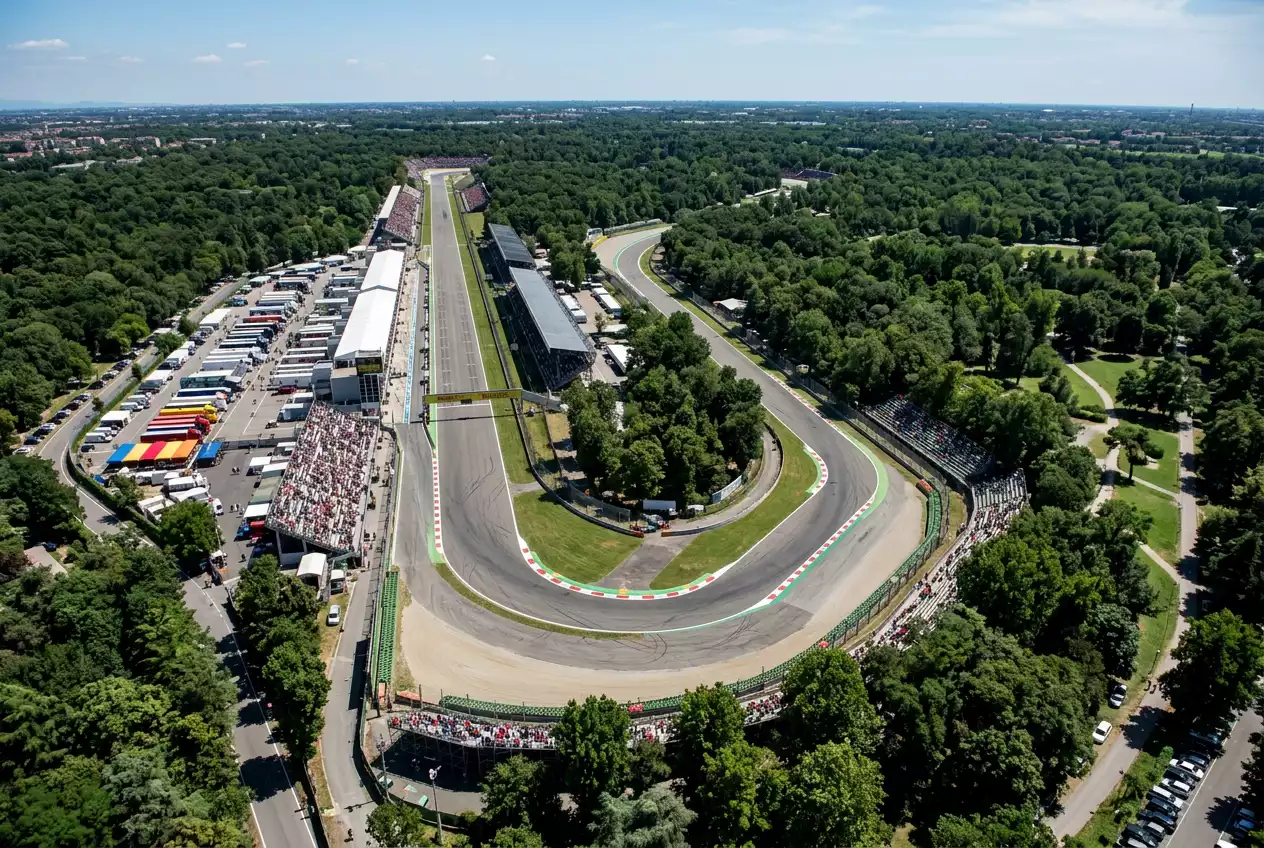
The Temple of Speed Demands a Different Bet
Monza 2020 was the race that pays for my season every time I retell the story. Pierre Gasly, driving for AlphaTauri, won the Italian Grand Prix at odds north of 100/1. A red flag, a penalty for the pre-race favourite, and a perfectly timed restart combined to produce one of the most astonishing results in F1 history. I did not back Gasly that day — nobody sensible did. But I had backed “safety car yes” and an each-way position on another mid-grid driver, and both landed. Monza rewards the bettor who understands its chaotic potential, not the one who backs the fastest car and walks away.
The Autodromo Nazionale di Monza is the fastest circuit on the F1 calendar. Average speeds exceed 260 kilometres per hour. Cars run trimmed-out, low-downforce configurations to maximise straight-line speed through the long flat-out sections that define the circuit. This aerodynamic setup creates a competitive dynamic unlike any other race: the engine-power hierarchy matters more, the slipstream effect is amplified, and the cars are more sensitive to aerodynamic disruption in traffic. For bettors, Monza recalibrates the season-long form book because the car characteristics that win here are not the same ones that win at high-downforce circuits.
Circuit Characteristics and Their Betting Impact
Monza’s layout is defined by three long straights connected by chicanes and one high-speed complex (the Lesmo corners and Ascari). The straights account for roughly two-thirds of the lap time, which means engine power and aerodynamic efficiency dominate the performance equation. A team with the best power unit but a mediocre chassis can be genuinely competitive at Monza, while a team with the best chassis but a weaker engine will find itself exposed on the straights.
The chicanes — first and second chicane, Ascari — are heavy-braking zones where overtaking happens. DRS is highly effective at Monza because the slipstream effect on the long straights, combined with the open DRS flap, gives the trailing car a significant speed advantage into the braking zone. Monza produces more on-track overtakes than almost any other circuit on the calendar, which means qualifying position is less dominant here than at circuits like Monaco or Hungary. A driver who qualifies fifth or sixth has a genuine chance of racing to the podium on Sunday.
This overtaking frequency has a direct betting implication: race winner odds at Monza are typically wider than at track-position circuits. The favourite might be priced at 2.00 or 2.50 rather than the 1.50 you see at Monaco, because the market recognises that grid position alone does not determine the result. For each-way bettors, the wider spreads at Monza mean better value on mid-priced drivers — particularly those in cars with strong straight-line speed but weaker overall downforce.
The Low-Downforce Wild Card
Every team in F1 brings a specific low-downforce rear wing to Monza — a “spoon wing” or a flat-element configuration that sacrifices cornering grip for straight-line speed. The quality of this specific component varies between teams, and it is not always the team with the best standard-configuration car that has the best Monza-specific package.
This equipment variation creates a competitive reshuffle that the market is slow to absorb. Practice sessions on Friday are the first time the Monza-specific wings run on track, and the speed-trap data from FP1 and FP2 reveals which teams have got the balance right. If a mid-grid team is topping the speed traps in practice by a significant margin, their Monza-specific aero package is working well, and their race odds should shorten — but the market adjusts gradually, giving you a window between the Friday data and Saturday qualifying to take a position.
The 1.83-billion global TV audience watches Monza for the spectacle of cars hitting 360 kilometres per hour through the Parabolica. For bettors, that spectacle translates into a specific analytical task: identifying which teams have optimised their speed-trap performance without catastrophically compromising their cornering. The team that hits the sweet spot — fast enough on the straights to overtake, stable enough in the chicanes to not lose the time back — is the value play at Monza.
Historical Trends and Monza Betting Patterns
Monza has a higher rate of surprise results than most permanent circuits. Over the past decade, non-favourites have won at Monza more frequently than the calendar average, driven by the circuit’s overtaking opportunities, safety car disruption, and the competitive reshuffle from low-downforce configurations. The tifosi — Ferrari’s passionate home fans — pack the grandstands and create an atmosphere that is emotionally overwhelming, but the betting data tells a more nuanced story: Ferrari’s home advantage at Monza is smaller than the crowd’s enthusiasm suggests, because the circuit does not consistently suit their car’s strengths.
Safety car frequency at Monza runs slightly below the calendar average because the chicane run-off areas allow stricken cars to be recovered without a full-course neutralisation. However, when a safety car does appear at Monza, its impact is magnified because the compressed field on the restart can produce multi-car incidents into the first chicane. The safety car market at Monza is typically priced around even money, and the edge comes from assessing whether the specific field dynamics of the current season — aggressive driving from mid-grid teams chasing points, rookie drivers in their first Monza race — push the actual probability above or below the market’s implied figure.
The fastest lap market at Monza behaves differently from high-downforce circuits. Because tyre degradation is relatively low on Monza’s smooth surface, the fastest lap can come earlier in the final stint than at a high-degradation track. The driver who sets the fastest lap at Monza often does so through a combination of a tow (slipstream) from a car ahead and a fresh set of tyres, rather than a dedicated late-race pit stop for fastest-lap hunting. This shifts the fastest-lap probability toward drivers running in the midfield group, where the tow effect is strongest, rather than the isolated race leader.
Monza’s Place in the Season Calendar
The Italian Grand Prix typically falls in September, at a point in the season when the championship picture is clarifying but not yet decided. For season-special bettors, Monza is a checkpoint: results here can confirm or challenge the mid-season narrative. A championship leader who dominates Monza on a circuit that does not naturally suit their car sends a powerful signal about their season trajectory. A leader who struggles at Monza on the low-downforce configuration may face similar challenges at other late-season speed circuits, which should influence your championship outright position.
Monza also marks the beginning of the autumn fly-away calendar, with races in Singapore, Japan, and the Americas following in quick succession. The team that arrives at Monza with a strong development trajectory is often the team that closes the season strongest, because the September upgrades carry forward through the remaining rounds. Watching Monza not just as a standalone betting event but as a data point for the season’s final third is the kind of structural thinking that separates weekend punters from season-long strategists.
