
 Available in US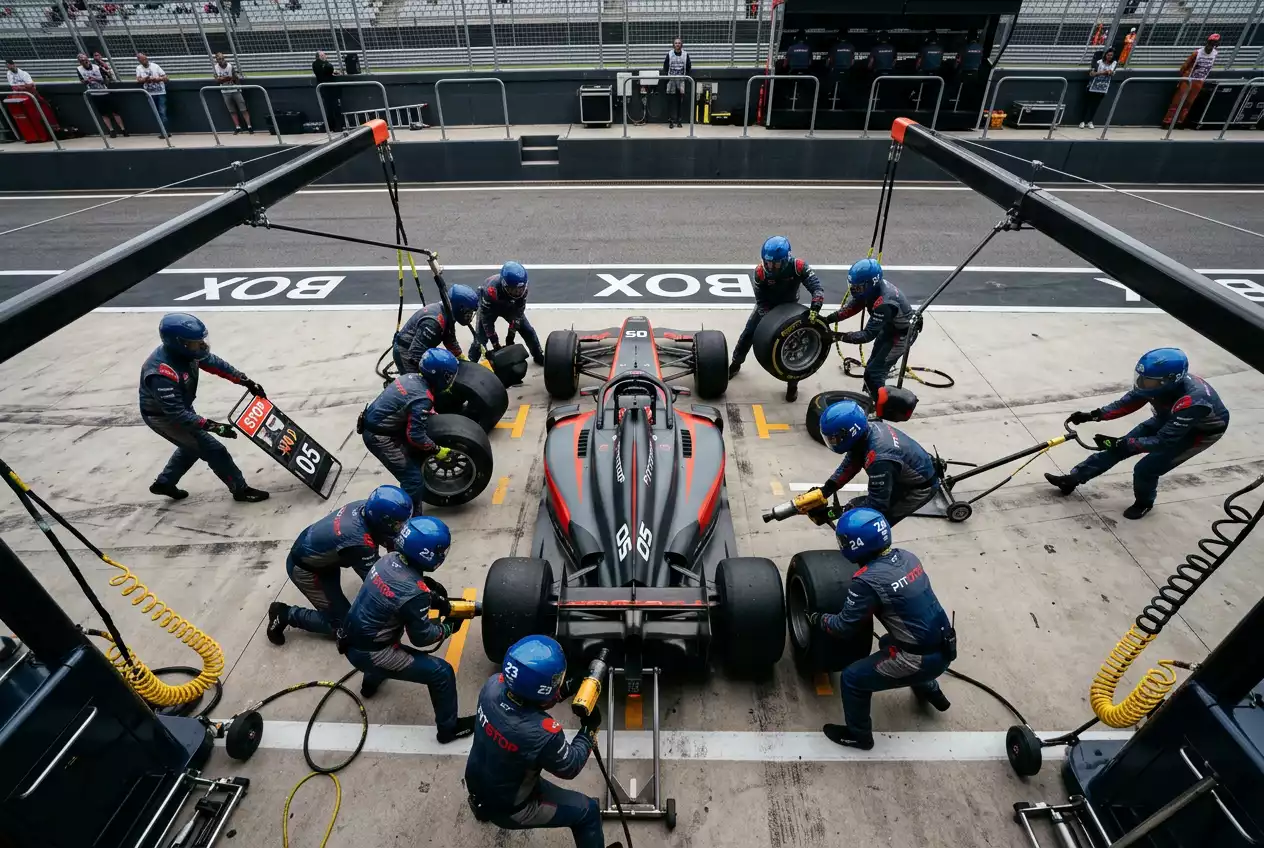
Two Seconds That Move Millions
The fastest pit stop in 2023 clocked in at 1.80 seconds. The slowest that same weekend took over eleven. That nine-second gap between the best and worst pit crew on a single race day is not a curiosity — it is a market. F1 pit stop betting has grown from a novelty side market into one of the most data-rich wagering opportunities in motorsport, and the punters who understand the mechanics of a sub-two-second tyre change are finding edges that the headline markets cannot offer.
I have been tracking pit stop times since 2019, initially just for fun, then as a genuine part of my race-weekend analysis. The patterns are remarkably consistent: the same two or three teams dominate the fastest-stop rankings year after year, and the variance within those top teams is surprisingly low. That consistency is what makes pit stop markets tradeable rather than random.
What Pit Stop Markets Actually Offer
Pit stop betting breaks into several sub-markets. The most common is “fastest pit stop of the race” — which team or driver will record the quickest stationary time. Some operators also offer head-to-head matchups between teams on pit stop speed, and over/under markets on the fastest stop time (will the quickest stop be under 2.0 seconds, for example).
The fastest-stop market is more predictable than it looks. Certain teams invest heavily in pit crew training and equipment. Their mechanics rehearse tyre changes hundreds of times between races, and the marginal gains they extract — shaving a tenth here, optimising the gun angle there — compound into a structural advantage that persists across an entire season. Backing the same team for fastest pit stop at every race is a crude strategy, but over a twenty-four-race season, it lands more often than not.
Sixty-three per cent of motorsport bettors wager between one and a hundred pounds per month. Pit stop markets fit perfectly into that budget: the stakes are typically modest, the odds offer decent returns, and the outcome is determined by a single measurable event rather than the complex, multi-variable puzzle of a full race result.
Data Patterns in Pit Stop Performance
Here is what seven years of tracking pit stops has taught me. First, the fastest stop almost always comes from a team near the front of the grid. This sounds obvious, but the reason is not just crew quality. Front-running teams have more planned stops at optimal moments, better positioning in the pit lane, and less chaos around their garage. A mid-grid team making a stop under safety car conditions, with five other cars pitting simultaneously, is more likely to have a slow stop because of traffic in the pit lane and pressure on the crew.
Second, the fastest stop of the race disproportionately occurs during the second or third pit stop, not the first. First stops carry the highest pressure — the crew is cold, the strategic stakes are highest, and a fumbled wheel nut can cost positions. By the second stop, the mechanics are warmed up, the adrenaline has settled, and the stationary times drop. If you are betting on fastest pit stop time as an over/under, the likelihood of a sub-2.0-second stop increases with each subsequent pit-stop phase of the race.
Third, track temperature affects pit stop execution. In extreme heat — think Bahrain, Qatar, Singapore — tyre temperatures in the blankets are higher, the wheel nuts expand fractionally more, and gun operation requires marginally more precision. Cooler circuits tend to produce faster aggregate pit times. It is a small effect, but it nudges the over/under line in a direction that the market does not fully account for.
Pit Strategy and Its Influence on Race Winner Markets
Beyond the dedicated pit stop markets, pit strategy is a powerful input for race winner and podium betting. The number of pit stops a team plans — one-stop versus two-stop — directly affects when they will be fast and when they will be vulnerable during the race.
A one-stop strategy means the driver stays out longer on each set of tyres, accepting slower lap times in the later part of each stint but saving the time cost of an additional pit stop (roughly twenty-two to twenty-five seconds per stop, depending on the circuit). A two-stop strategy sacrifices that time but runs on fresher rubber for more of the race, producing faster individual lap times. The optimal choice depends on tyre degradation, circuit characteristics, and where the driver is running in the field.
For betting, the strategy divergence between drivers is the key signal. When the leader commits to one stop and the driver in third commits to two stops, the race becomes a calculation: will the two-stopper’s pace advantage on fresh tyres overcome the twenty-two-second pit-stop deficit? I have found that degradation data from practice sessions answers this question with reasonable accuracy. If the degradation rate is above 0.10 seconds per lap, a two-stop strategy usually wins. Below 0.06, a one-stop strategy holds. The zone between those numbers is where the market is most uncertain and the value for informed bettors is highest.
Pit stop execution also matters more than most bettors realise. A slow stop — four seconds instead of two — costs two seconds of real time, which can be the difference between emerging ahead of or behind a rival after a pit-stop cycle. If you know that a team has a history of slow stops (check the aggregate pit stop rankings published after each race), their race-winner odds should carry a small discount for execution risk. The market does not price this consistently, which is an edge for anyone who tracks the data.
When Pit Stops Go Wrong: Betting on the Unexpected
A botched pit stop is one of the most dramatic moments in F1, and the market reaction is immediate and sharp. A wheel gun failure, a cross-threaded nut, a released car that narrowly misses a mechanic — these incidents add ten, twenty, sometimes thirty seconds to a stop, and they can drop a podium contender to the back of the field in an instant.
You cannot predict individual pit stop failures, but you can build them into your risk assessment. Teams with a history of pit stop errors carry higher variance — their best-case outcomes are excellent, but their worst-case outcomes are catastrophic. For accumulator bets or bet builders, including a driver from a high-variance pit crew adds hidden risk that the odds do not reflect. I factor pit crew reliability into every multi-leg bet I build: if two legs depend on the same team executing clean stops, I have doubled my exposure to that team’s execution risk.
The 2026 season brings continued focus on pit-stop regulations following recent changes to minimum pit-stop times and equipment specifications. These regulatory shifts can disrupt the established hierarchy of pit crew performance. When regulations change, the early-season data carries extra weight — teams that adapt quickly to new equipment gain an edge that the market, priced on prior-year reputation, is slow to recognise. The first three or four races after a regulation change are the richest value window in pit stop markets.
