
 Available in US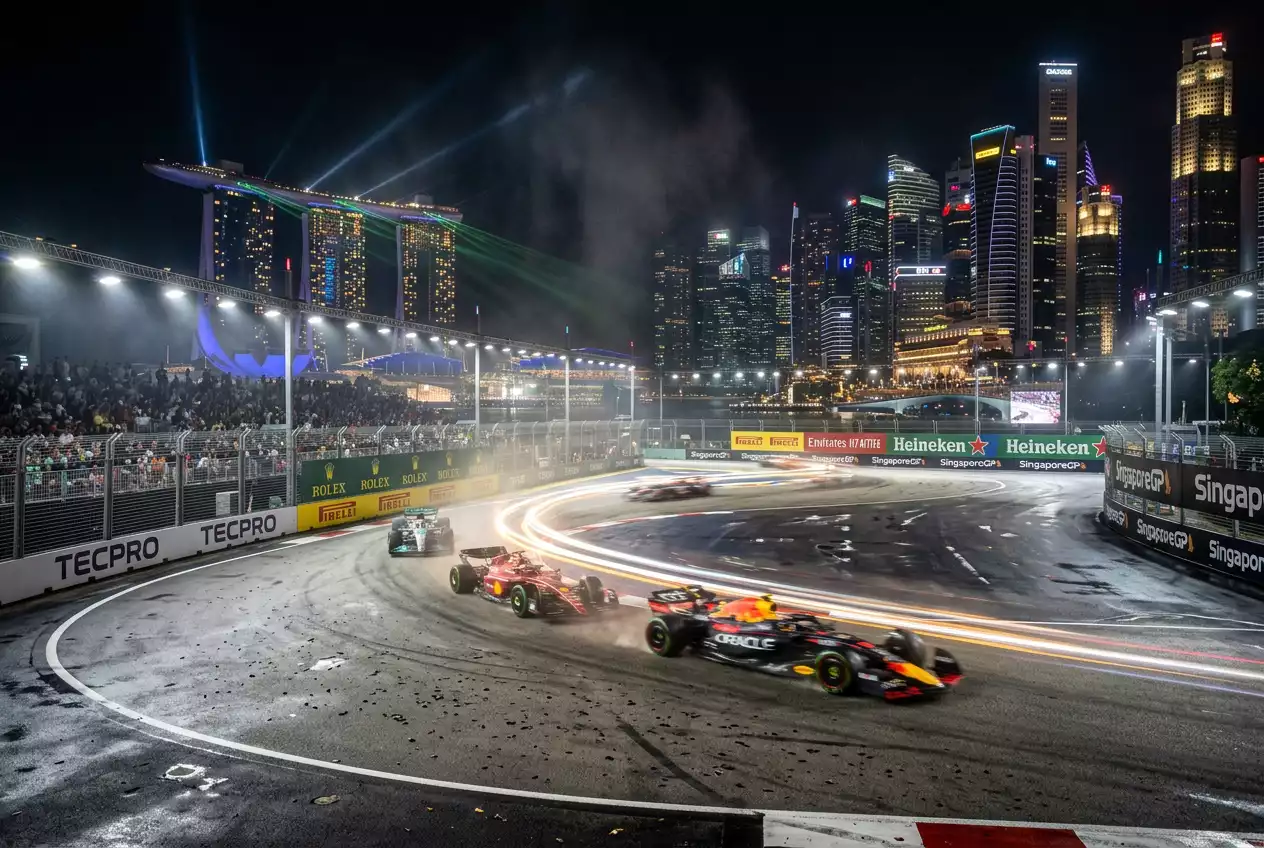
Betting Under Floodlights: A Different Kind of Grand Prix
Singapore 2023 knocked out four of the top six pre-race favourites through a combination of mechanical failures, wall strikes and a strategic gamble that went spectacularly wrong. I had two each-way positions running that night, both on drivers priced between 10/1 and 16/1. One finished on the podium. The other hit the wall on lap thirty-four. That is Singapore in a sentence: rewarding for the prepared, brutal for the unlucky.
Marina Bay is the original night race on the F1 calendar, and the floodlit setting is not just spectacle — it fundamentally alters the competitive landscape. The race runs in the evening, when ambient temperatures in Singapore hover around thirty degrees Celsius with humidity north of seventy per cent. Those conditions create a physical endurance test unlike any other on the calendar. Drivers lose two to three kilograms of body weight during the race through sweating alone. Concentration lapses from fatigue cause errors, and errors at a street circuit mean barriers, punctures and retirements. Twenty-eight per cent of F1 fans placed an online bet in the past year, and Marina Bay is the kind of event where that bet carries maximum volatility.
Marina Bay’s Street Circuit Characteristics
What separates Marina Bay from other street circuits — Monaco, Jeddah, Las Vegas — is the sheer number of corners packed into a relatively short lap. Twenty-three turns in 4.94 kilometres means constant braking, constant turning, constant acceleration. The car is rarely going in a straight line. This punishes power unit performance and rewards mechanical grip, low-speed traction and a chassis that responds predictably in the ninety-degree direction changes that characterise the circuit.
For bettors, this circuit profile inverts the usual competitive hierarchy. Teams dominant at high-speed circuits like Spa or Monza frequently underperform at Singapore, while teams that have struggled with straight-line speed but excel in low-speed mechanical grip come alive. The annual shift in form at Singapore is one of the most reliable market inefficiencies on the calendar. I track each team’s relative performance at low-speed circuits throughout the season — Monaco, Hungary, and then Singapore — and use the trend to identify which constructors the market has underpriced.
The tight confines also mean safety cars. Marina Bay produces safety car deployments in over seventy per cent of its races, similar to Monaco. But unlike Monaco, the safety car at Singapore often triggers genuine position changes because the pit-lane layout allows for faster stops and the circuit has a few spots where overtaking is possible — Turn 5 and Turn 7 offer braking zones where a driver on fresh tyres can lunge past a rival. Safety car timing at Singapore is the single most influential factor in determining which strategy wins.
Heat, Humidity and Driver Endurance as Betting Factors
The cockpit temperature during the Singapore Grand Prix can exceed fifty degrees Celsius. Ninety per cent of F1 fans report emotional investment in race outcomes, but the physical toll on drivers at Marina Bay goes beyond emotion into raw physiology. Drivers whose fitness or heat acclimatisation is subpar make more errors in the second half of the race — mistimed braking, wider apex entries, slower reaction times to safety car restarts.
This endurance factor creates a specific betting angle. Younger drivers who are physically fresh and older drivers who have extensive experience managing fatigue tend to outperform at Singapore relative to their season averages. Drivers in the middle — those with neither the raw fitness advantage of youth nor the cognitive management skills of experience — are the ones who fade. I look for drivers whose second-stint lap times at past Singapore races were unusually slow compared to their first-stint pace. That pattern, if it repeats, tells you the driver struggles with the physical demands and is likely to lose places in the second half of the race.
The heat also affects the cars. Engine cooling is maximal at Singapore because the low speeds reduce airflow through the radiators. Teams may need to turn down engine power to manage temperatures, which narrows the performance gap between power units. A team with the fastest engine on the grid gains less at Singapore than at Spa or Monza, which compresses the odds and makes mid-field constructors more competitive.
Strategy and Pit Stops Under the Marina Bay Lights
Singapore is traditionally a one-stop race with the possibility of a two-stop if the safety car timing aligns. The narrow pit-lane entry and exit add two to three seconds compared to faster pit lanes, making an extra stop proportionally more expensive. Teams are reluctant to pit twice unless forced by circumstances — which is why a well-timed safety car can transform a driver’s race by offering a free pit stop that would normally cost too much track position to justify.
The tyre behaviour at Marina Bay is unique. The street surface is abrasive and bumpy, which produces high degradation in the initial laps before the tyres “grain” and then stabilise at a lower but consistent performance level. Drivers who manage the graining phase patiently — accepting a few slow laps early in the stint rather than pushing — emerge with better tyre life for the remainder of the stint. This patience factor is not visible in qualifying times but shows up clearly in race-stint data from practice.
Live-betting windows at Singapore are defined by safety car deployments. When the safety car appears, the market reprices around two scenarios: leaders who pit and maintain position, and leaders who stay out and risk being overtaken by drivers on fresher rubber. The correct bet depends on the remaining race distance and the tyre age differential. If the leader has been running for twenty laps on mediums and a safety car appears at the halfway point, the market almost always underprices the probability that a well-timed pit stop from a chaser will flip the podium order.
Why Singapore Favours the Contrarian Bettor
The 827-million-strong global fan base tunes in for the night-race spectacle, and the casual money flows toward familiar names. But Singapore’s unique combination of physical attrition, frequent safety cars, low-speed circuit characteristics, and heat-induced performance variance makes it one of the best races on the calendar for contrarian bettors.
My approach is simple: identify the two or three teams whose low-speed performance exceeds their championship standing, find drivers within those teams who have historically performed well at street circuits, and back them each-way at odds that reflect neither their Singapore-specific form nor the high probability of a safety car disrupting the expected order. Singapore is not a race where the favourite cruises to victory — it is a race where the field converges, chaos intervenes, and the bettor who has done the granular work ends the night in profit.
